


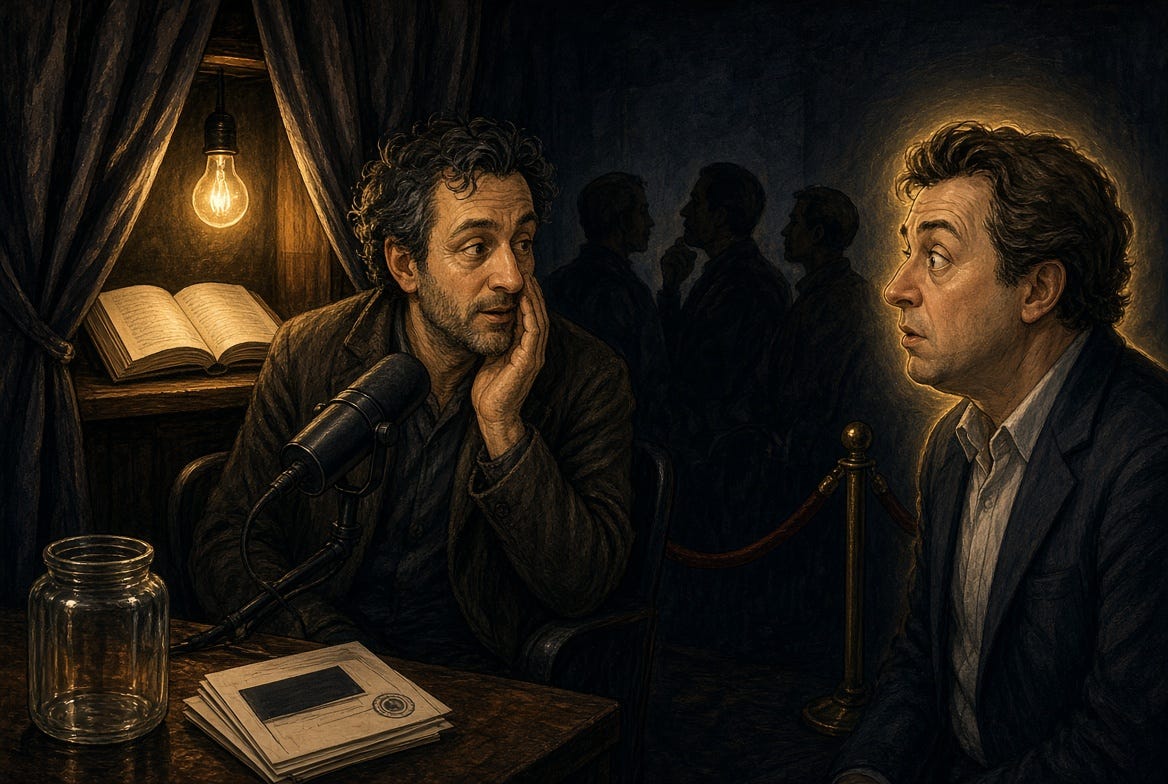
“They’re all lying to you. They didn’t want to teach you this. You were purposefully bamboozled.
No one knows the truth, except for me. And now if you listen to me, you’ll know the REAL truth.”
This is the hidden knowledge sales pitch in online sectors like politics, religion, and finance, with the intention of massaging your ego more than your intellect.
I usually don’t name podcasts because then it becomes about that individual rather than the point I’m making.
Recently, there have been podcasts that have been seen as incredibly divisive and yet they have a hardened, loyal fanbase. They don’t just have controversial guests on, they have guests who purposefully counter the narrative.
I would see people commenting, “Why would X have X person on their podcast?! They’re a kook!”
It’s because the host is either infatuated with the guest or is purposefully using hidden knowledge to keep their audience glued.
What is hidden knowledge? Hidden knowledge isn’t information you just didn’t know. It’s information that was supposedly kept from you.
The key word is “hidden,” meaning it was an act of hiding something. It’s meant to imply that this information was kept from you, on purpose, and supposedly for a nefarious reason.
The nature of learning is that you are consuming information that you didn’t know prior. That’s not a conspiracy. That’s just the normal process of learning. What these people do is weaponize this process by convincing adults that the reason you lacked this knowledge is that someone was trying to manipulate you.
It comes with the presumption that you should know just about everything now as a functioning adult, and the fact that you didn’t know X detail must mean that someone took it away from you.
Mind you, hidden knowledge doesn’t necessarily mean that it’s correct information. It just means it’s counter-information.
The pushers of hidden knowledge pump up the ego of their listeners as being an audience of geniuses who are thirsty for information and only they are smart enough to know that this counter-information is the real information.
The rest of the world is filled with fools, but you, yes you, are special. You’re curious enough to ask the right questions and find the right answers by going to the real sources. It’s a massive ego trip.
We are in the era of counter-culture and counter-information. These aren’t inherently bad, but it takes a critical mind to decipher what is real and what is nonsense. The problem is that we have people who trust sources rather than information.
I’m not a fan of CNN, but not everything coming from CNN is fake. Not everything from Fox News is completely honest. And your favorite blog does have a bias. Not all information should be weighed the same, and just because you didn’t know something doesn’t mean it was withheld from you.
Consider that you didn’t know something simply because you were never exposed to the idea before. It’s not a conspiracy when a five-year-old was never told about thermodynamics. The reality is that you will never know everything, and even if you’re an expert, you can get things wrong.

The podcast world has amped up the angles of hidden knowledge, and it’s playing with the minds of its listeners, who think they’re being enlightened but they’re getting scammed with information.
I’m a consumer of all types of content, and it’s not just politics. It’s finance podcasts that give airtime to a “guru” who is in his mid-20s and claims to drive nothing but exotic cars and live a lavish lifestyle by teaching people how to get rich. I’ve literally watched a finance podcast applaud a guy who is telling their audience how to commit bank fraud.
The hosts always say the same thing: “Wow. I never knew that. How come they don’t tell us about this?” Well, because fraud is a crime, and the guy sitting across from you (who probably paid to get on that podcast) is a criminal.
As a Christian, I listen to Christian podcasts and commentary, and the obvious con men always push hidden knowledge. That line of scripture you thought was straightforward is actually the wrong interpretation.
You were being lied to, and now listen to them because only they know the truth. They often anoint themselves as prophets while providing no inkling of a prophecy.
People fall for these charlatans because hidden knowledge is enticing, and even with God, people want to feel that they know Him better than someone else.
So, how do you protect yourself from hidden knowledge pushers? First, lose your ego. Humble yourself and don’t make everything about you. Just because you didn’t learn about something by the time you were 30 doesn’t mean that some information puppeteer orchestrated it.
Second, measure it against the real world. If a finance guy is telling you some quick scheme to make money, ask successful people (or if you don’t know any, listen to their interviews) how they made their money.
Legitimate successful people usually make their money over a span of years and have failed multiple times along the way. You’ll quickly realize there was no hidden knowledge involved, just boring stuff you already knew.
Third, look for your thrills elsewhere. Part of the reason people like hidden knowledge is that it’s so counter-narrative that it’s exciting. It’s like your best friend telling you a secret, making you a part of this exclusive club of information holders.
Lastly, if you want help spotting them, they often use buzzwords like “Truth” all the time. If you have to say the word, it probably isn’t true. Things that are, are.
They don’t need exaggeration, disclaimers, or reassurances. If they call themselves a “truth teller,” they are likely full of sh*t. Who calls themselves a “lie teller”? No one. Being truthful is implied.
If they say “look it up,” it’s to disarm you and encourage you not to look it up. It’s to get you to say, “Why would someone lying tell me to look something up?” The pause and asking of that question is exactly what they want.
The presupposition is that the world is far more malicious and callous than you believe. There is always a plot, and they are your information saviors. This is the victim-savior dynamic, because without their podcast, you’d never know the truth.
This is the audience they want. An audience of victims who are simultaneously too smart to fall for the mainstream.
But if you want the most secret of secret knowledge, subscribe and join their Patreon for $20 a month.
Will Rogers had a quote regarding hidden knowledge, but alas I can't find his witty statement. Essentially his point was that people like hidden knowledge because it makes them feel superior to others who are still ignorant of it I would add to it that hidden knowledge pretends to be a short cut solution to all the hard work necessary to build a business or to understand a subject. And there is the hidden knowledge on why your life isn't working or things are wrong in the world. There is this secret (fill in the blank). I am back to reading a book everyday. Not for hours as I did as a kid. I confess that my reading muscle is very flabby. I feel for the young that grew up without books. The effort must seem insurmountable.
Yes, all this is very much true. However, after the horrific psyops that've been perpetrated against us, we're rightly suspicious for the most important knowledge, held by TPTB, has indeed been hidden from us, to our detriment. But I agree that blind allegiance to any particular influencer is folly; for example, I believe that Candace Owens is right about everything to do with Charlie Kirk's assassination, but am very disappointed in her throwing Trump under the bus. And on the other hand, I'm down with the Promethean Updates ladies' take on Trump's long game, but non-plussed that they dissed Candace's investigations as "a distraction." Also; just because I defend the people of Gaza against the genocidal Israeli government, doesn't mean I'm down with the invading hordes of Muslims all over Europe and North America.